SL Colonies Roleplay
 Breedables Guide For Second Life · How to Earn Linden Dollars in Second Life

SL Colonies Roleplay is a medieval survival, farming, crafting and trading roleplay game in Second Life (SL)
Running since 2019. Free to play: no entry fee, no subscription.
Visit the official website or the SL Colonies Emporium in-world.
Overview
In SL Colonies Roleplay, every item in the economy was gathered or made by a player. Characters gather resources, farm, raise livestock, hunt and craft at stations placed on player-owned regions across the grid, and trade what they make with each other.
The game is built so that nobody can comfortably do everything alone. Each trade owns its own stations and recipe book, so progress means visiting other people's land, using stations they built and trading for materials somebody else gathered.
Getting started

- Get the free HUD and meter from the dispenser at the SL Colonies Emporium, or have them delivered from the Start your journey page.
- Attach the HUD and register through it.
- Pick a trade and start gathering.
The HUD tracks a character's professions, stats, inventory and tools; the meter tracks health, energy, hunger, thirst and the rest of their survival stats. The full walkthrough, with videos, is at slcoloniesroleplay.com/start-your-journey.
Twelve trades
Each trade is levelled only by working it, and each depends on the others for what it cannot make itself. See what each trade makes.
 Brewer |
 Butcher |
 Carpenter |
 Cook |
 Farmer |
 Herbalist |
 Merchant |
 Ranger |
 Seamstress |
 Smelter |
 Smith |
 Woodsman |
A thirteenth role, Colonist, is the placeholder a new character registers as. It has no bench of its own, and taking a trade is a separate choice.
Races
There are 41 playable races. Each shifts six attributes up or down, and those attributes set how much health, energy, hunger and thirst a character can carry. See the races.
Farming
Fields are rezzed on a player's land and come in three sizes — small, medium and large — in four kinds: field, vegetable field, vineyard and wet field. A herb garden supplies the herbalist, and a compost bin turns pig dung into fertiliser for the fields.
 Field |
 Vegetable field |
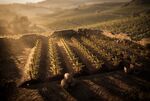 Vineyard |
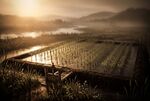 Wet field |
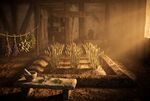 Herb garden |
Livestock
Animals eat the crops players grow, and what they produce feeds other trades. A bull turns one dairy cow into two over a fourteen-day cycle, supplying milk to the kitchen and beef to the butchers, while pigs supply the dung the compost bin needs.
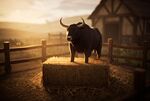 Bull |
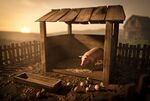 Pig Pen |
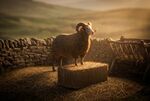 Ram |
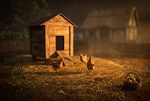 Chicken Coop |
Gathering
Gathering needs the right tool, and tools are crafted by other players and wear out with use. Orchard and forest trees are felled with a lumberjack axe and grow back on their own; ore seams need the matching pickaxe and return at different rates, so iron is back on a sim days before silver or gold. Fishing pools are rezzed underwater and worked with a crafted rod. Honey comes home in a clay pot rather than a basket, and reed becomes the baskets and bags the colony gathers with.
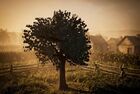 Oak tree |
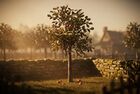 Apple tree |
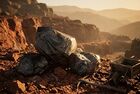 Iron vein |
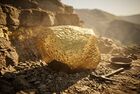 Gold vein |
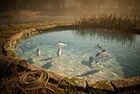 Fishing pool |
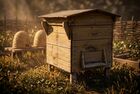 Beehive |
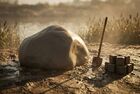 Clay mound |
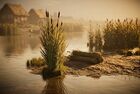 Reed plant |
Alongside these are berry bushes, fig, fir, lemon, lime, maple, olive, orange and cherry trees, copper and silver veins, sand pits and water sources. The full list, with what each one gives and which tool it needs, is at Treasure.
Crafting
Raw materials are worth little until somebody works them, and each crafting station belongs to a trade. Ore goes to the smelter and comes back as ingots, which the forge and anvil turns into tools and the coin mint strikes into coin. Logs are cut at the logging station into planks for the carpentry and furniture benches. Hides pass through the leather tanner and leather rack; wool, cotton and flax through the spinning wheel, loom, sewing table and dye tank. Grain is milled at the flour mill for the cooker station, carcasses are broken down at the butcher table, and fruit and honey ferment at the wine press, mash tun, fermentor and distiller before bottling.
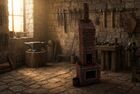 Forge & Anvil |
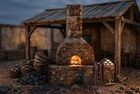 Smelter |
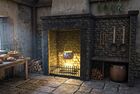 Cooker Station |
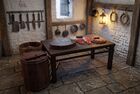 Butcher Table |
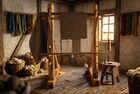 Loom |
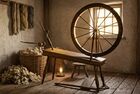 Spinning Wheel |
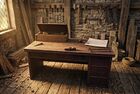 Carpentry Station |
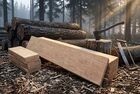 Logging Station |
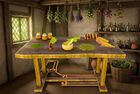 Herbalist Table |
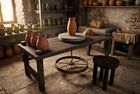 Pottery Station |
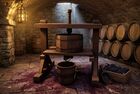 Wine Press |
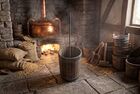 Mash Tun |
There are around two dozen stations in all, including the alchemy station, basketweaving station, bottling station, compost bin, dye tank, fermentor, distiller, aging barrels, furniture station, sewing table, leather tanner, leather rack and coin mint. Each is listed with the recipes it can run at Treasure.
Hunting and weapons
Hunting supplies hide, meat and experience, and it is the one part of the game that can kill a character.
 Deer |
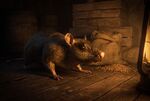 Rats |
 Wolf |
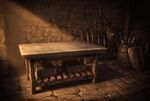 Weapon Crafting Table |
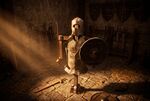 Practice Dummy |
A deer notices a hunter at 32 metres and runs, and every one gives up a hide. Rats have a single point of health and come back about every half hour, so a cellar full of them is a steady trickle of ingredients. A wolf is the only huntable that fights back: it is faster than a player, hits hard and rewards the ranger who brings it down.
Weapons are made by smiths at the weapon crafting table, sharpened on a sharpening stone and mended at the repair bench — durability runs down with use, and a weapon that reaches zero is gone for good. A practice dummy hits back with numbers, so a player can measure a weapon without spending an animal to learn what it does.
Colonies, trade and the economy
A colony is the group a player belongs to: a house, a bloodline or a guard. See the colonies.
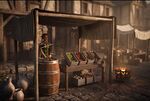 Marketplace HUB |
 Multi Item Vendor |
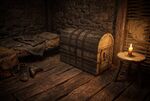 Storage Chest |
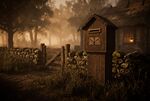 Mailbox |
The market hub will trade with anyone, and charges for the privilege: it buys at well under an item's value and sells at well over it. Player vendors price inside that gap, which is what makes running a shop worth doing. Mailboxes and storage chests move and hold goods between players, and prices across the colonies are visible on the market board.

Separately from the in-game coin economy, members sell sealed crates of goods to each other for Linden dollars on the Trading Post. The seller sets the price and keeps every Linden; the game takes no commission.
For land owners

A region server brings a parcel into the shared economy. It hands out the tools players need to gather, mine, chop and forge on that land, lists the realm in the public directory and gives the owner a page of their own to write. Owners then stock the land with the fields, stations, gatherables and animals their realm needs, and set their own theme and rules — from pirate harbours to irradiated wastelands.
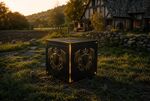 Region Server |
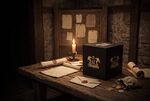 Quest System |
The quest system adds jobs of the owner's own writing: a quest giver can be dropped into any object — a villager, a statue, a noticeboard — and every step a player completes is counted as they do it. See Give your land something to do and the realms directory.
Links
- Official website
- SL Colonies Emporium (in-world)
- Second Life Marketplace store
- Community forum
- Discord
- YouTube